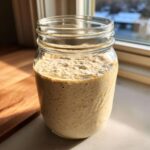
Description
Follow this simple, day-by-day guide to create an active sourdough starter using only flour and water.
Ingredients
Scale
- 100g Whole Wheat or Rye Flour (for initial days)
- 100g Unbleached All-Purpose Flour (for later days)
- 100g Unchlorinated Water (room temperature)
Instructions
- Day 1: Mix 50g of whole wheat or rye flour with 50g of room temperature water in a clean jar. Stir until fully combined. Cover loosely and let it sit at room temperature (68-75°F) for 24 hours.
- Day 2: You may see small bubbles or no change. Discard half of the mixture. Add 50g of whole wheat or rye flour and 50g of water to the remaining starter. Mix well, cover loosely, and wait 24 hours.
- Day 3: Discard half of the starter. Add 50g of all-purpose flour and 50g of water. Mix well. You should start seeing more activity. Wait 24 hours.
- Day 4: Discard half. Feed with 50g of all-purpose flour and 50g of water. If you see significant bubbles, you can switch to feeding twice a day (every 12 hours).
- Day 5 & 6: Continue discarding half and feeding with 50g all-purpose flour and 50g water twice a day (morning and evening). The starter should become very bubbly and increase in volume after feeding.
- Day 7: Your starter should reliably double in size within 4 to 8 hours after feeding. It smells pleasantly sour, not like acetone. It is now active and ready to use for baking.
- Maintenance: To maintain, feed your active starter daily if kept at room temperature (discard half, feed 1:1:1 ratio of starter:flour:water). If storing in the refrigerator, feed it once per week.
Notes
- Use a clear jar so you can watch the rise and fall of the starter.
- The best temperature for initial activity is between 70 and 75 degrees Fahrenheit.
- If your starter smells like nail polish remover (acetone), it is hungry. Feed it immediately.
- Always use unchlorinated water, as chlorine can inhibit wild yeast growth.
- Prep Time: 5 min
- Cook Time: 0 min
- Category: Baking Basics
- Method: Fermentation
- Cuisine: General
Nutrition
- Serving Size: 100g
- Calories: 200
- Sugar: 0.5
- Sodium: 1
- Fat: 0.5
- Saturated Fat: 0.1
- Unsaturated Fat: 0.4
- Trans Fat: 0
- Carbohydrates: 40
- Fiber: 2
- Protein: 5
- Cholesterol: 0